 Dance, Music, & Song Camps
“Fabulous music and dance in a magical setting.”
–Lorraine Graves
August 23-29, 2026 // Plymouth, MA
Renaissance, baroque, and medieval music for players and singers of all levels
Join our community Facebook group!
Program Description
Are you passionate about medieval, Renaissance, and Baroque music, especially as revived and played on period instruments? Do you also love nature and being in community with others? If so, this is the week for you!
Early Music Week offers joyful opportunities and challenges to players, singers, dancers, and listeners at every level, from novice to highly experienced. As classes unfold through the week, we explore and discover the connections that lie behind some of the world’s most vibrant and compelling early music. We dance together every day, connecting with dancers and musicians in a unique and spontaneous way, so different from a class or a concert hall—in the pavilions under the pine trees.
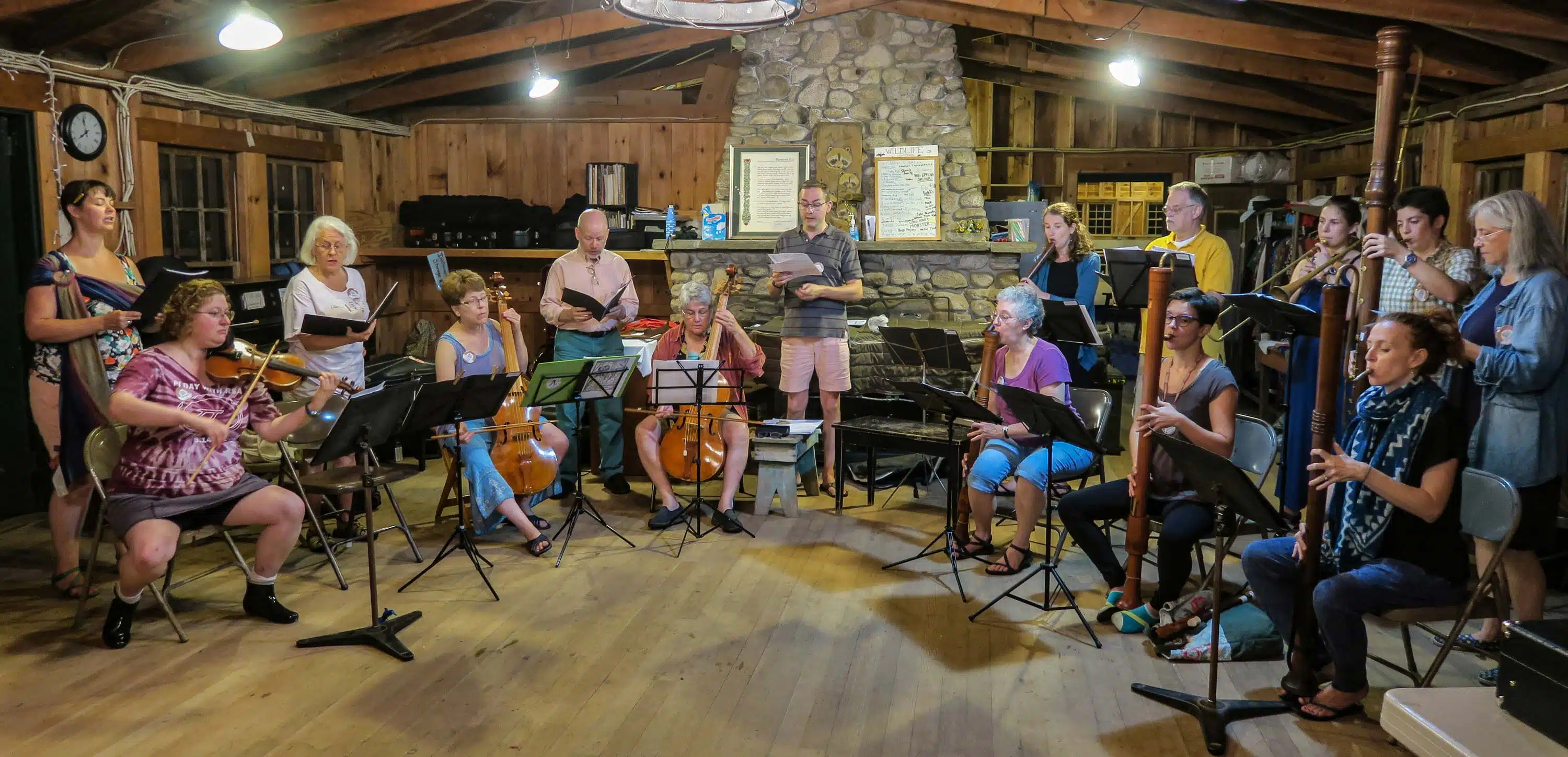
At Early Music Week, instrumentalists can focus intensively on their primary instruments, enjoy the opportunity to play with others in mixed ensembles, yet also find time to explore something completely new. Singers can delve into early music repertoire in small groups, sing in a chorus or collegium, or try an introductory instrumental class. Everyone is invited to enjoy English country dancing, with instruction during the day for all levels. The week also features an English dance band class, lectures on early music topics, a dedicated space for our LGBTQ+ community to meet and talk, an outstanding faculty concert, and various performing opportunities for our participants. The daily family-style meals are delicious!
Classes meet daily from Monday to Friday, with four class periods each day. Second period offers English dance classes for everyone. From morning music to late-night consorts, early music fills the air.
Emperor of the Moon
The moon has long inspired a sense of wonder and mystery. Ancient superstition decreed that the moon influenced our humors or even caused an altered emotional state! On the scientific side, its gravitational pull affects the ocean tides and life cycles of marine wildlife.
Our theme takes its name from Aphra Behn’s 1687 play The Emperor of the Moon, a light-hearted farce in the Italian commedia dell’arte style. A mesmerizing tune with the same title then appeared in The Dancing Master in 1690. In the play, the protagonist Dr. Baliardo is obsessed with the moon and believes it to be inhabited; eventually, the crazed doctor believes he is visited by the Emperor of the Moon and all the characters of the zodiac. Behn was among the first female British authors to earn a living from her writing, defying society’s expectations and becoming a role model for later generations. She also worked as a spy for Charles II! We’ll honor her legacy with a treasure trove of classes on topics both celestial and earthly:
- Music with cosmological references, including troubadour songs; consorts for voices, recorders, viols, and double reeds; Baroque ensembles; an English voices and viols project; and more
- Medieval Collegium: “O Fortuna Velut Luna” explores the 13th-c. Carmina Burana manuscript
- “Mad songs,” Italian commedia dell’arte, broadside ballads, and Restoration theatre music
- Folk tunes on early instruments, Renaissance dance rhythms, and ECD class “A Motley Collection”
- Early notation, sight transposition, arranging ECD tunes, and ensemble rehearsal tips
- Our very own Pinewoods Vespers, to sing our praise to the moon
The moon will be full on the Friday of EMW… who knows what musical antics it may inspire? Join us and see!
–Karen Burciaga, Program Director
Schedule
Arrival and Departure
Sunday Arrival Schedule:
| 3:00 p.m. | The earliest you can start arriving at camp |
| 4:30-6:00 | Welcome party / lifeguard on duty for swimming |
| 6:00 | Tour of camp starting from the Camp House |
| 6:30 | Dinner |
| 7:45 | Orientation gathering |
| 8:15 | Opening night dance and party |
Saturday Departure Schedule:
| 7:45-8:15 a.m. | Breakfast |
| 10:00 a.m. | Final departure |
Draft Daily Schedule
| 7:45 a.m. | Breakfast |
| 8:15 | Stretches and vocal warm-ups |
| 9:00-10:15 | Period 1 |
| 10:45-11:45 | Period 2: English country dancing by level |
| 12:30 p.m. | Lunch |
| 2:00-3:00 | Period 3 |
| 3:20-4:20 | Period 4 |
| 4:30-5:00 | Tea time |
| 5:00-6:30 | Side-by-sides / free time |
| 6:30 | Dinner |
| 7:45 | Evening events (lectures, concerts) |
| 8:15-9:45 | Evening dance |
| 9:45 onward | Special events and after-dance activities |
Class Descriptions
Classes meet daily from Monday to Friday. There are four class periods each day. Second period is English dance classes for everyone.
Campers will receive a self-rating guide and class questionnaire with acceptance emails after March 16.
- Classes will be assigned based on your experience level and the interests you indicate in the class questionnaire. Experience level abbreviations:
- Beginner (B)
- Low Intermediate (LI)
- Intermediate (I)
- Upper Intermediate (UI)
- Advanced (A)
- All music classes are cumulative and include small ensemble work and are not in a drop-in/out format. Please plan to attend all assigned classes Monday-Friday.
Pitch is A=440 for most classes.
Period 1
Instrumental and vocal consorts grouped by level
(all levels, recorder, viol, violin family, voice, double reeds)
Start your day in a consort of like instruments where you’ll have the opportunity to strengthen your technique, practice ensemble skills, increase comfort with your voice or instrument, and discuss all questions in a supportive environment.
Introduction to the Recorder—Miyo Aoki
(B, recorders)
This friendly session will introduce you to that most beloved of instruments, the recorder! Intended for those with little or no recorder experience, by week’s end the class will have you feeling good about the basics and ready to play simple, satisfying tunes.
Sight-Transposition Boot Camp—Niccolo Seligmann
(LI and up, all instruments)

The piece is written in D, but the singer can’t sing it in any key higher than C. What do you do? This common situation has many bad solutions, but only one good solution: develop the skills to transpose on sight. Different strategies work for different people, but all of these strategies require a great deal of repetition. It’s not glamorous work, but once you can do it, you can always do it, and your singer will thank you.
Arranging English Country Dance Tunes—Karen Axelrod
(LI and up, all instruments)
Learn how to arrange a delightful array of tunes for dances, for fun, or for concerts. We’ll start by playing through some 3-part arrangements of English country dance tunes and analyze what’s going on with each line. Then, we’ll work on creating our own arrangements as we explore bass lines, fill, countermelodies, and rhythm variations. As a group, we will invent ideas for each tune, with lots of focus on listening and responding. We’ll also look at how to create a dance-length arrangement of a tune, with an emphasis on how to tell a story and create an arc for the piece.
Advanced Vocal Ensemble—Michael Barrett
(A, voices)
For experienced singers, this class will work on a variety of issues, including vocal technique, interpretation, strategies for successful ensemble music-making, overcoming performance anxiety, and other issues that participants are interested in exploring. Join us if you’re interested in feeling better about singing on your own and singing together!
Advanced Baroque Ensemble—Alastair Thompson
(A, flute, recorder, violin family, all continuo instruments)
For advanced players, the class will sample 18th-c. chamber music in various instrumentations while addressing concepts of phrasing, affect, tempi, ensemble work, and musicianship.
Period 2
English Country Dancing: An Introduction, and Then On We Go!—Jan Elliott
(B)
On Monday and Tuesday, we’ll start with the basics of ECD so that you can then join Melissa’s class and enjoy the evening dances for the whole week.
ECD For All—Melissa Running, with Alastair Thompson and Karen Burciaga
(LI and up)
If you want to expand your previous English country dance experience, this class is for you. We’ll review some figures and vocabulary so you feel confident on the dance floor. We’ll learn a variety of dances and focus on style and the pleasure of dancing well, dancing with each other, and enjoying each other’s company, while seeing how the music informs the choreography. You’ll get to know dances that will also be called at the evening events, so you’ll be able to dance with style, confidence, and good cheer.
Experienced ECD—Tom Roby, with Karen Axelrod and Emily O’Brien
(A)
English country dance has tunes and choreographies from across the centuries. Aimed at those who dance regularly, this class will offer a wide array of ECD’s gems, familiar and unfamiliar, historical and modern. Some dances will offer new challenges, but above all we will focus on the fun of dancing well together and the pleasure of supporting our fellow dancers. Tolerance for confusion and cheerful recovery skills are required, in addition to familiarity with all common ECD figures.
Period 3
Medieval Collegium: O Fortuna Velut Luna—Niccolo Seligmann and Ben Matus
(all levels, all voices and instruments)
“Fortune, changeable like the moon.” These words from a 13th-century manuscript, made famous by Carl Orff, have become a pop culture phenomenon on the level of the Eiffel Tower and Mona Lisa. Centuries before Orff, medieval people believed in the Wheel of Fortune–the method by which the powerful Lady Fortune raises you from the muck, puts you on the throne, and casts you down again into the muck. This program explores the concept of Fortune’s Wheel, with repertoires from the 13th-15th centuries—including the manuscript on which Orff based his famous Carmina Burana. This special project will have the chance to perform on Friday before the participants’ concert.
Arlecchino on the Run—Dan Meyers
(all levels, all instruments, voices, dancers)
The traditions of commedia dell’arte, popular around Europe in the 16th and 17th centuries, involved troupes of skilled street performers, both men and women, who told timeless stories in words, movement, and song; improvised much of what they did on the spot; and influenced the developing art form of Italian opera! Join us as we learn to embody the hilarious stock characters of commedia dell’arte, play 16th-century Italian tunes, and develop our own improvised performance based on a commedia canovaccio, or scenario, from the Renaissance.
Ethereal Light: Songs of the Troubadours—Sian Ricketts
(LI and up, voices and soft instruments)
Troubadours were the composer-performer rock stars of the Middle Ages, and we are fortunate to have a wealth of their music to learn from. Many of these monophonic (one voice) poetic songs tell of courtly love, while others delve into the metaphysical realm of religion, existence, and the great beyond. We’ll focus on pieces that mention celestial bodies, and together we’ll develop our own interpretations of these beautiful voices from the past.
Folk Melodies—Jan Elliott
(LI and up, all instruments)
Dive into the world of folk music and its centuries-long friendship with “art” music. We’ll sample tunes from the Irish, English, and French bal folk traditions, and maybe even try some Balkan tunes with “crooked” rhythms. We’ll emphasize danceability, i.e. choice of tempo, clear articulation, and finding a groove that will get onlookers dancing despite themselves.
All for One: Making the Most of Your Ensemble Rehearsal—Michael Barrett
(I and up, all instruments and voices)
Does the rehearsal time with your ensemble ever feel stuck, or like you’re moving backwards instead of forwards? This class will combine discussions and music-making to consider issues around good ensemble rehearsal practice, from using time wisely and sharing ideas to non-verbal cues. Participants will take turns being the “first among equals” for the ensemble in our judgement-free zone. Bring your questions!
On the Fringe: A Visit to Bedlam—Eric Haas
(I, recorders, strings, voices)
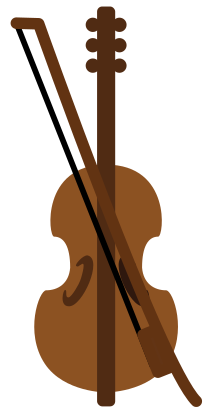
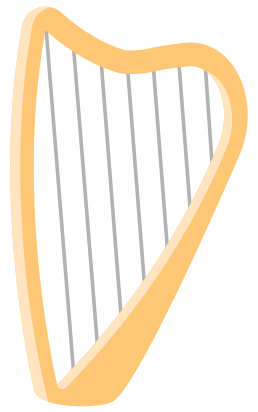
The notion that the phases of the moon can alter our mental state dates back to antiquity. We’ll explore 16th- and 17th-c. interpretations of the lunar influence, and we’ll make a musical visit to Bedlam (the nickname of London’s notorious psychiatric asylum, St. Mary of Bethlehem): Coprario’s “Mad Tom of Bedlam;” Byrd’s “Unto the Hills” (and other settings of Psalm 121); Capillas’s “Cui luna;” and more. Mostly four parts, suitable for recorders, viols, and voices.
Above the Stars: English Verse Anthems—Joshua Overby and David Hunt
(I and up, voice, viol, organ, sackbut)
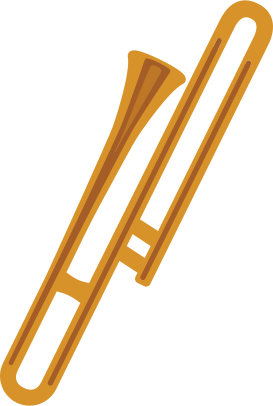
The 17th-c. English verse anthem enjoyed a place that spanned public liturgy and private devotion, where a spiritual cult of royalty contrasted with its sensual poetry and music, and in an age when art had assumed political dimensions. We will delve into a selection of these pieces—by notable composers such as John Bull and Orlando Gibbons—as they may have been sung, played, heard, and enjoyed in the context of private or collegiate devotions: with a Consort of Viols as the choice accompaniment to our noble Quire. Many have cosmological references; together we’ll venture towards orbs, stars, and the great unknown. All ensemble and solo singers welcome! You’ll choose your own adventure with intrepid solo verses, grand choruses, or things in between as you desire.
Renaissance Dance Rhythms—James Williamson and Alastair Thompson
(I and up, all instruments, dancers)
Pavans, galliards, and voltas, oh, my! In this class we’ll explore popular dances of the Elizabethan era from both the dancers’ and the musicians’ viewpoints. We’ll look at the rhythms, tempi, and phrasing that best suit the unique style of each dance, then together play examples of music from across Europe. We’ll talk about what makes music danceable, then observe and try the steps ourselves to learn what the dances look and feel like in the body. Both musicians and dancers welcome—you may play, dance, or do both as you wish.
Moonlit Riddles: Canons, Puzzles, and Other Musical Enigmas—Héloïse Degrugillier
(UI, recorders)
Renaissance and Baroque composers delighted in musical riddles—enigmatic canons, hidden lines, and whimsical puzzle pieces meant to tease both performer and listener. In this consort-focused class for upper-intermediate recorder players, we explore canonic tricks and eccentric musical devices that delighted early musicians. Expect everything from straightforward imitation to notational curiosities designed to bewilder… in the most enjoyable way.
A Little Night Music—Mary Springfels
(UI and up, viols)
English and Italian songwriters of the early modern era were fascinated by themes of darkness and melancholy. Viols will explore 16th and 17th-c. consort music in moods both melancholic and lively by Ward, Holborne, and, of course, Dowland, the famously doleful composer of Lachrimae or Seaven Teares.
Lieblich gedackt—Miyo Aoki
(A, recorders)
Become a rank of organ pipes in this class of transcriptions of keyboard works by Buxtehude and Bach. Keyboard composers from the Renaissance and Baroque often conceived their music in four or more contrapuntal voices, which makes it perfectly suited to playing on a consort of like instruments.
Period 4
Pinewoods Vespers—Joshua Overby
(all levels, voices)
Some people hear the term “vespers” and automatically assume that Monteverdi is close behind, but the term is actually Latin for “evening.” Right around the time the sun goes down and the moon peeks her face, Christians would attend these vesper services filled with prayer, reverence, and thanksgiving. Join us as we explore this beautiful and solemn music that was caressed by moonlight in centuries past—and perhaps we’ll sing to the full moon on Friday. Open to everyone who wants to sing.
Give Me the Moon, the Sun, and the Dog’s Anger—Ben Matus
(all levels, all voices and instruments)
The moon and sun direct the flow of a day, the tides, and… music?? In our class, we will explore Renaissance music from facsimile both by learning the principles of interpreting the notation and by playing and singing together. This class is open to all who read music (either vocally or instrumentally). Experience with clefs is helpful but not necessary. By the end of the week, we’ll hear music in a different way with the guidance of the moon and sun and understand that the title of the class is potentially the nerdiest pickup line ever conceived.
Climbing the Ladder—David Hunt and Karen Burciaga
(all levels, all voices and instruments)
Set foot into the world of broadside ballads, masque tunes, and the slippery slopes of social rank! Together we will explore a variety of 17th-c. music that trod the blurry lines of respectability and refinement: bawdy tunes from the scandalous royal masques and sensuous ballads printed for the people on cheap paper. This is the perfect class to build some material for Skit Nights present and future. Open to all, with plenty of room for playing, singing, dancing, oration, improvisation, and other musically disreputable activities.
Diana, Goddess of the Moon and the Hunt—Niccolo Seligmann
(LI and up, all voices and instruments)
In Ancient Rome, Diana was goddess of both the moon and the hunt. Songs referencing Diana and hunting were popular in 14th-century France and Italy. Often in canon, these hunting songs or “cacce” pair intricate polyphony with goofy animal sounds! Try a sampling of these pieces in the most perfect setting honoring the goddess of Nature: the trees of Pinewoods.
Well Met by Moonlight—Mary Springfels
(I-UI, viols)
L’amoroso Ero is a set of madrigals, published in Brescia in 1588, which tells the story of ill-fated lovers Hero and Leander. This divine 5-part music includes works by Marenzio and Ferrabosco the Elder and is perfectly suited to play on viols.
ECD from the First Millennium: A Motley Collection—Tom Roby with Karen Axelrod
(I and up, dancers)
To honor the composer of the tune for the dance Emperor of the Moon, Richard Motley, we will include several dances to his tunes in an otherwise motley collection of dances published no later than the year 2000. Although most historical ECD dances have no known composer, we will feature dances where we know something of the composer or the provenance of the tune.
Humors Under the Full Moon: Expressing Human Emotion in Ensemble—Héloïse Degrugillier
(I and up, recorders, flutes, strings, continuo)
Early modern thinkers believed that the moon could stir our humors and shape our emotional lives. This class explores Baroque composers who depicted those shifting inner worlds—joy, melancholy, ardor, despair, serenity—through harmony, texture, and rhetorical gesture. We will dive into expressive pieces by both well-known and lesser-known composers, shaping phrases with sensitivity to text, affect, and the theatrical imagination of the period. We will also experiment with how ensemble sound becomes a mirror of the human heart.
The Two(?) Aleottis: Motets and Madrigals by Raffaella and/or Vittoria Aleotti—Michael Barrett and Sian Ricketts
(UI and up, voice, recorder, flute, viol, violin family)
We don’t know whether Raffaella and Vittoria Aleotti were the same person, but we do know that women faced significant challenges as musicians in the 16th and 17th centuries. One of the most common outlets for musical expression was as a member of a convent, as was the case for Raffaella, who published a major collection of motets in 1593. Vittoria, meanwhile, appeared among the composers represented in a collection of madrigals and motets. Our class will explore this fascinating repertoire in arrangements for voices and instruments.
Theater Music of the Restoration Era—Emily O’Brien
(UI and up, recorders)
In 1660, King Charles II’s restoration to the English throne began a period of renewed interest in the theater. His love of the arts meant that new music constantly appeared for the many new plays written that decade, among them Aphra Behn’s Emperor of the Moon. We’ll explore a variety of late 17th-c. music composed for the English stage to accompany dramatic entrances, humorous exits, fantastical characters, melancholy songs, quirky dances, and more.
Howling at the Moon—James Williamson
(UI and up, viols)
We will explore the consorts of Thomas Lupo (which means “wolf” in Italian), a key figure in the repertory of the Jacobean consort. Writing at the end of the century, the music theorist Thomas Mace lists Lupo in his his list of “best authors now deceased” of the old style of music which could “[dispose] us to Solidity, Gravity, and a Good Temper, making us capable of Heavenly and Divine Influences.” Come be transported and transformed by these lesser-known gems of the viol repertoire.
Isorhythmic Motets: The “Math Rock” of the Late Middle Ages—Dan Meyers
(UI and up, loud Renaissance winds)
In an attempt to bring the music of humanity closer to the music of the spheres, some late medieval composers wrote a highly structured style of motet based on repeated, interlocking melodic and rhythmic figures, arranged in strict proportions. Despite this seemingly dry mathematical approach, some of these pieces are nonetheless quite beautiful, and a delight for the ear and the fingers as well as the mind. We’ll learn what isorhythmic composition is, how it was done, and how composers like Machaut, de Vitry, and Dufay used simple building blocks to create intricate and challenging music.
Stargazing with Orlando—Miyo Aoki
(A, recorders, low strings)
The heavens have always served as inspiration for creators of all kinds of art, and music is no exception. In turn, scientists have also been inspired to find music in their own disciplines. The early 17th-century mathematician and astronomer Johannes Kepler ascribed certain musical intervals to each planet and surmised that together they produced a kind of cosmic counterpoint, and composers of all eras have taken inspiration from celestial bodies for their own compositions. In this class we’ll play music centered around celestial objects—the sun, the moon, and more! Music by Giles Farnaby, Orlando di Lasso, Juan Vasquez, and others. String players will mostly play lower parts since recorders will play at 4-foot pitch.
Dance Terminology
CDSS camps use a variety of calling terms, including gendered and non-gendered role terms, as well as positional language, at the discretion of each week’s Program Director. Read more about CDSS and dance calling language here.
| English country dance | Positional |
Registration and Fees
Camp fees cover all accommodation, meals from dinner on the arrival day to breakfast on the departure day, and all of the various dance, music, and song events in the program.
This year, all of our weeks have sliding scale pricing for adults to help make camp financially accessible to more people. The fee you choose will not affect your chance of getting into camp.
How it works:
- The standard camper fee covers program staff pay and travel costs, facility fees, and all of the other costs associated with running this camp week.
- The higher price options allow you to add an additional amount to your registration fee to help make camp more accessible to more people. Thanks for supporting this community!
- If the standard camper fee doesn’t work for you, no worries! Feel free to choose one of the lower price options.
- If the lower price tiers still leave camp out of reach for you, we encourage you to apply for a scholarship and/or work exchange. See our Scholarships page for more details
| Standard Fee (2026) | |||||
|---|---|---|---|---|---|
| $785 | $915 | $1,045 | $1,175 | $1,305 | $1,435 |
Staff