 Dance, Music, & Song Camps
“Imagine getting to spend a week with equally enthusiastic nerds—dancing, singing, swimming, and eating good food to your heart’s content—this utopia exists at Harmony of Song & Dance!”
Lisa Keegan
August 8-13, 2026 // Plymouth, MA
For singers who love to dance and dancers who love to sing
Join our community Facebook group!
Listen to Harmony Week featured on “Off the Path” from WSHU Public Radio.
Program Description
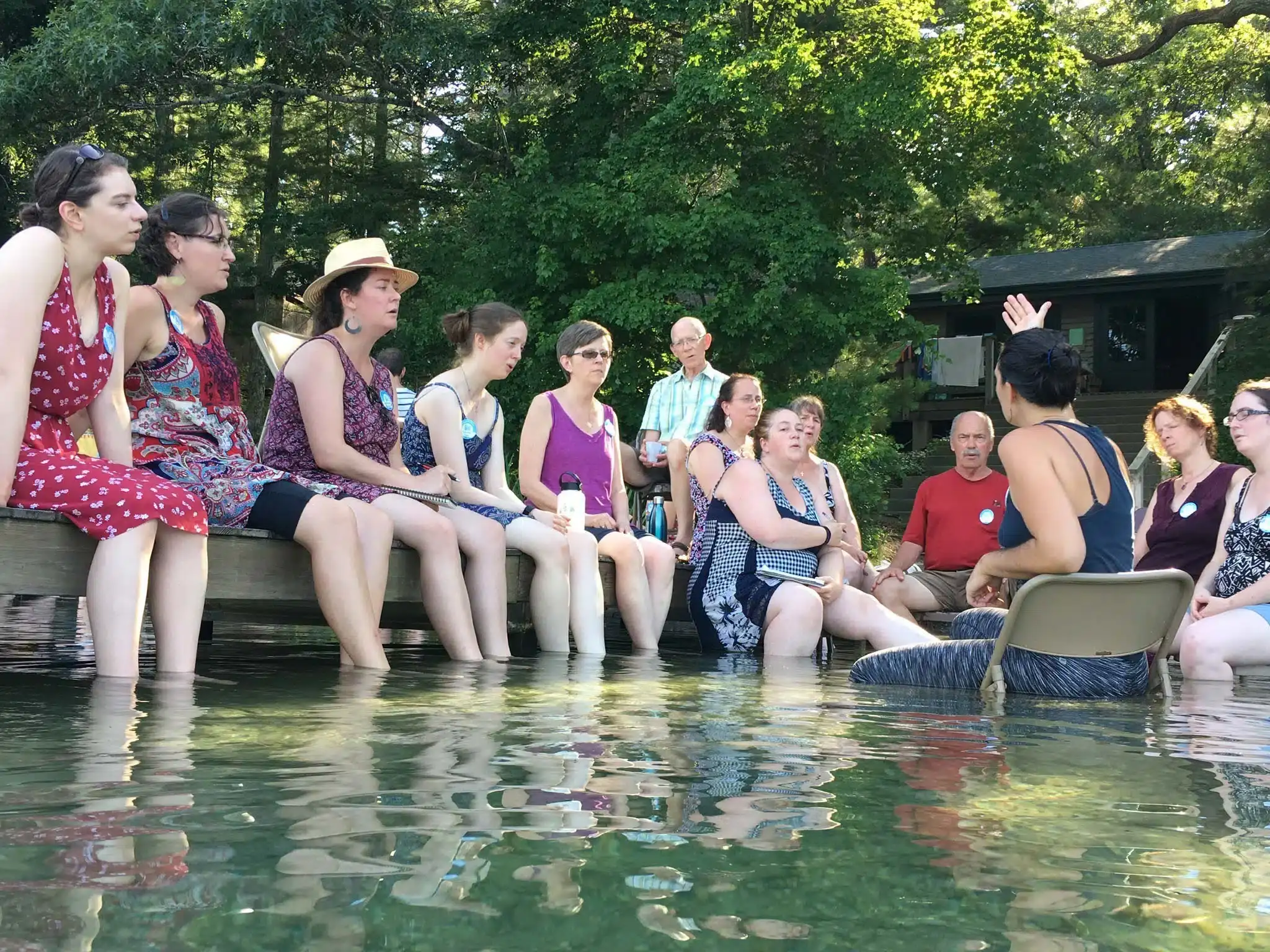
Do you love to sing, dance, jam, or do all of those at the same time? If so, then this session is for you!
Every morning, we have dance classes where both newcomer and experienced dancers will find a lesson for their skill level, followed by an all-camp singing session. After a break for swimming and a delicious lunch, we have an afternoon full of workshops on a wide variety of song repertoire, singing styles, instrumental repertoire, instrument technique, partnered dancing, ritual dance, calling, music history, and more. There is also an hour before dinner where we’ll have a few staff-led jams, but campers are also very welcome to host jams, conversations, and parties too!
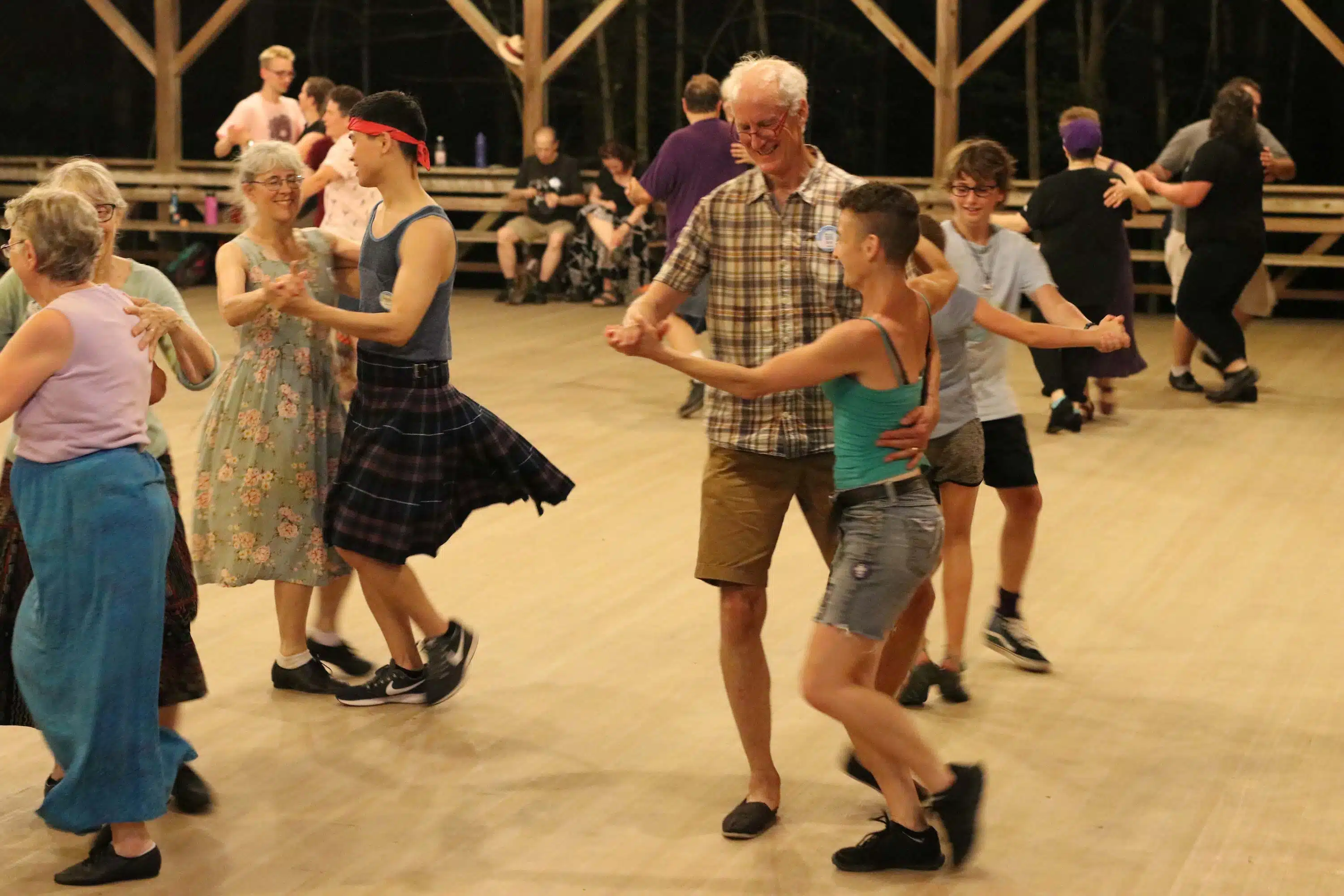
After dinner we will enjoy mini-concerts by our brilliant staff followed by a dance featuring contra and English country dancing, plus late-night pub singing, ceilidh dancing, and more. Within each jam-packed day, there is also time built into the schedule for jamming, snoozing, swimming, chatting, or taking some solo time if you need it. Pinewoods offers a beautiful venue for a glorious week of song, dance, learning, connection, revelry, and rejuvenation. I look forward to singing and dancing with you there!
-Nicole Singer, Program Director
Schedule
Arrival & Departure
Saturday Arrival Schedule:
| 3:00 p.m. | The earliest you can start arriving at camp |
| 4:30-6:00 | Welcome party / lifeguard on duty for swimming |
| 6:00 | Tour of camp starting from the Camp House |
| 6:30 | Dinner |
| 7:30 | Orientation gathering |
| 8:15 | Opening night dance and party |
Thursday Departure Schedule:
| 7:45-8:15 a.m. | Breakfast |
| 10:00 a.m. | Final departure |
Draft Daily Schedule
| 7:45 a.m. | Breakfast |
| 9:00-10:00 | Class Period 1 |
| 10:15-11:15 | Class Period 2 |
| 12:00 p.m. | Lunch |
| 1:15-2:15 | Class Period 3 |
| 2:30-3:30 | Class Period 4 |
| 3:45-4:45 | Class Period 5 |
| 5:00-6:00 | Late afternoon jam, sing, chat, and swim |
| 6:00 | Dinner |
| 7:15-8:00 | Mini-concert |
| 8:15-10:15 | Evening dance |
| 10:30 onward | After-dance activities |
Class Descriptions
Period 1
Next-Level Contra and ECD—Ben Sachs-Hamilton and Adina Gordon, with various musicians
Already confident with the basic figures and techniques of English and contra? Come start your morning with some fun dances from both traditions that will help you further develop your skills as a supportive partner and neighbor on the dance floor.
Find Your Footing in Contra and ECD—Maia McCormick
New to contra and/or English country dance? Know the figures in theory but still don’t feel totally comfortable with them? Then this is the session for you! We’ll focus on building skills and confidence in contra and ECD via a little bit of teaching and plenty of dancing. (Bonus: more experienced dancers can learn tips and tricks to help others on the dance floor!)
Period 2
All-Camp Sing—Anna Patton with various staff
Each day, the whole camp gathers in one of the airy pavilions nestled in the woods to join our voices in song and harmony. Some of our fabulous singing staff will teach a variety of pieces from different singing traditions and styles. We’ll build a beautiful communal repertoire throughout the session and have a celebratory sing-through on the last day of camp.
Period 3
Country Harmony and the Carter Family—Sasha Hsuczyk
In this class, we will learn to sing early country style harmony using repertoire from some of country’s first legends, the original Carter Family. Using historic recordings, we will learn how to pick up a harmony by ear and how to create or improvise our own country style harmonies based off of the foundation of the Carter Family style. If you play guitar, banjo, fiddle, mandolin, harmonica, or any other country-friendly instruments, please bring them along!
Dance Variety Pack—Various callers and musicians
Come dance with us! Every afternoon, we’ll have a different flavor of dancing to enjoy during this hour. It may be contras, ECD, chestnuts, squares, advanced ECD, hambos, swing, schottisches, waltzes, ceilidh dances, or whatever else the dance band and caller(s) dream up! A more specific schedule will be posted closer to the beginning of camp.
Clawhammer Banjo—Joe Zavaan Johnson
Clawhammer is a banjo style frequently used in old-time music for its unique blend of melody and rhythmic accompaniment. In this workshop, you’ll learn your first tune on clawhammer banjo entirely by ear on your 5-string banjo. We’ll begin with the fundamentals you need to get started, including right and left hand technique and basic rhythmic patterns. As we work through learning your first tune by ear, we’ll also discuss how the banjo’s Black origins impact the clawhammer style we play today. Depending on student interest, we may also explore common tunings and strategies for continuing your learning journey. The workshop will be taught entirely by ear—bringing recording devices is highly encouraged!
Morris Dancing—Alice Kaufman with Alex Cumming
Description coming soon!
Shaker Bangers, or, an Introduction to Great Shaker Songs—Saro Lynch-Thomason
The Shakers are the longest ongoing communal society in colonized America’s history. This charismatic religious sect is best known for its vows of chastity and elegant furniture styles, but less known are the vast repertoire of beautiful songs maintained by its members for over 250 years. These songs often praise god in the feminine form, speak of the divine with nature-rich imagery, and celebrate communal cooperation and understanding. In this class, we’ll learn a variety of Shaker songs that are good to sing in groups and solo and some simple harmony pieces as well. Along the way, we’ll learn just how radical the Shakers were for their time and how the lessons of their songs resonate today.
Period 4
Traditional Irish Music: An Overview of the Sliabh Luachra Regional Style from Kerry and Cork—Sasha Hsuczyk
Come learn about the Sliabh Luachra regional style of traditional Irish music from counties Kerry and Cork. This mystical place in Ireland is known as the “rushy mountain” and is home to an old tradition of Irish music known for spirit-stirring polkas and slides that will get you feeling like jumping up to dance a set. We will talk about the history of the area, its musical influence, and explore and learn from the repertoire of some of the star musicians from Sliabh Luachra: Julia Clifford, Padraig O’Keeffe, and Denis Murphy. You will leave the class with some new polkas and slides to play at your local Irish music session! Sliabh Luachra music is best suited for the fiddle and button accordion, but all instruments from the Irish tradition are welcome. If you don’t play an instrument that is part of the traditional Irish lexicon but you want to give Irish tunes and rhythms a go on your instrument, you are welcome too!
Singing—Alex Cumming
Description coming soon!
Four Elements of Hip Hop—Joe Zavaan Johnson
Join Joe Z Johnson for workshops exploring the four essential elements that make up hip hop, a tradition rooted in Black and Latinx music and culture. Each class will focus on one of hip hop’s foundational elements—DJing, MCing, b-boying/b-girling, and graffiti—examining its roots in African diasporic traditions and tracing how it has evolved over time. We’ll discuss how DJing emerged from sound system culture and innovative turntable techniques, how MCing developed from oral traditions of storytelling and toasting, how b-boying/b-girling drew from diverse dance forms and community competition, and how graffiti became a vital form of Black cultural expression. Throughout these classes, we’ll consider how each element reflects broader cultural practices, community building, and artistic innovation, and how they came together to create hip hop as we know it today.
Southern Appalachian Ballads & Their Ancient Folklore—Saro Lynch-Thomason
In this class, Saro will teach some of her favorite ballads from Southern Appalachia, most prominently from North Carolina, Virginia, and Western Virginia. As we explore these story-songs, we’ll also learn about the old folk traditions and even mythologies embedded in these songs, so many of which have roots in England, Scotland, and Scandinavia. We’ll also spend some time on vocal technique and performance choices.
Callers’ Workshop—Adina Gordon with Kristen Planeaux
Are you curious about what callers do? Have you done some calling and want to advance your skills or try a new kind of calling? Squares, contra, English… whatever it is, Adina is here for you! Join her for an all-levels callers’ workshop and take the mic yourself. We’ll be joined by the brilliant Kristen Planeaux, who will provide music and wisdom on communicating and working well with musicians. If you have a dance (or several!) that you’re excited to work on, please bring it, but you are also totally welcome without a dance in mind too.
Period 5
Shape Note and Sacred Harp Singing—Sasha Hsuczyk
What better setting than Harmony of Song & Dance to sing some rousing four-part acapella harmony music out of the Sacred Harp songbook? No prior experience necessary, but all levels of familiarity welcome! Our main goal for this class will be to sing as much as possible, but we will contextualize our singing with history and lore about the Sacred Harp as well as shape note music theory. Shape note notation was designed to be easy to learn and make sight singing more accessible to all. Compositions welcome!
Swing Harmony Singing—Anna Patton
Sing harmony arrangements of American songs from the intersection of swing, blues, gospel, and folk. We’ll work on satisfying and sometimes tricky close harmonies, focusing on just a few songs during the session. Sheet music will be provided, but ear-learners are also welcome.
Take It!—Owen Morrison
Ever wonder what to do between verses of a song? This class will explore ways to create musical interludes using just one guitar. From short fills to extended chord melodies, guitarists will learn a variety of tools to enhance the instrumental part of any song. Participants should already be able to play several chords comfortably and be familiar with at least one strumming or picking pattern. You may send Owen a recording in advance if you would like help with a particular song.
Banjo Through Time—Joe Zavaan Johnson
Join Joe Z Johnson for classes that trace the banjo across centuries and continents, exploring how this iconic instrument has evolved and adapted throughout history. We’ll begin with the banjo’s African antecedents and follow its transformation as enslaved Africans created early gourd banjos in the Caribbean and Americas. From there, we’ll examine the instrument’s evolution through different eras: its adoption and adaptation in minstrelsy, its refinement during the classic era of banjo manufacturing in the late 19th and early 20th centuries, and its role in various American music traditions. We’ll discuss how design changes—from gourd to wooden rim, from gut to steel strings, from fretless to fretted—reflected and shaped the music played on the instrument, and explore the banjo’s modern forms and diverse uses today, from old-time and bluegrass to folk, jazz, and experimental music. Throughout, we’ll consider how the banjo has served as a site of cultural exchange, appropriation, and reclamation.
Movement & Protest Songs—Saro Lynch-Thomason
In this class, we’ll learn an energizing variety of songs from people’s movements in the U.S. and abroad: from coal wars in Appalachia to war resistance in Scotland, to the modern-day Poor People’s Campaign. We’ll enjoy a mix of call-and-response songs, rounds, zipper songs, and ballads. Along the way, we’ll take the time to explore what it is about the structure, imagery, and applied uses of these songs that has made them effective and emotive tools for change.
Late Afternoon
Camper-Led Activities
Workshops, jams, discussions, crafts, nature walks, or whatever else you dream up!
Dance Terminology
CDSS camps use a variety of calling terms, including gendered and non-gendered role terms, as well as positional language, at the discretion of each week’s Program Director. Read more about CDSS and dance calling language here.
| English country dances | TBD |
| Contra dances | TBD |
Registration and Fees
Camp fees cover all accommodation, meals from dinner on the arrival day to breakfast on the departure day, and all of the various dance, music, and song events in the program.
This year, all of our weeks have sliding scale pricing for adults to help make camp financially accessible to more people. The fee you choose will not affect your chance of getting into camp.
How it works:
- The standard camper fee covers program staff pay and travel costs, facility fees, and all of the other costs associated with running this camp week.
- The higher price options allow you to add an additional amount to your registration fee to help make camp more accessible to more people. Thanks for supporting this community!
- If the standard camper fee doesn’t work for you, no worries! Feel free to choose one of the lower price options.
- If the lower price tiers still leave camp out of reach for you, we encourage you to apply for a scholarship and/or work exchange. See our Scholarships page for more details
| Standard Fee (2026) | |||||
|---|---|---|---|---|---|
| $625 | $730 | $835 | $940 | $1,045 | $1,150 |
You can find more information about the registration process here.